
L1 · Architecture of trust
Is trust first institutional, relational or hybrid? It sets the weight of technological proof versus human relays.
Regional strategy · anthropology of trust
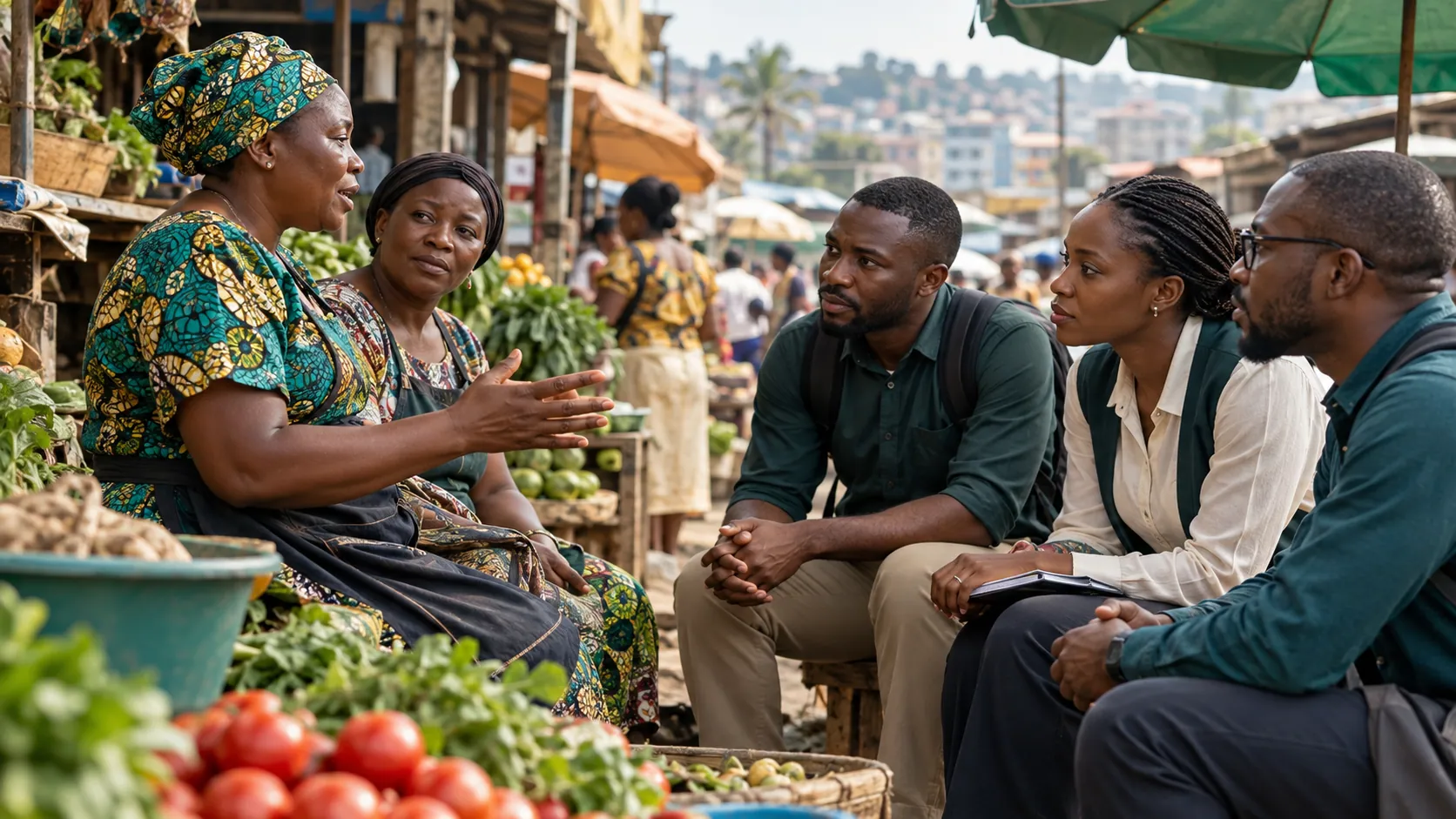
An identical platform can be massively adopted in one country and ignored in its neighbour — not for technical reasons, but because relays of trust, languages of use and the relationship to authority differ. The map says where to go; this says how to enter.
 AI illustration
Six lenses of trust
Rather than reasoning by ethnic group — a reductive and risky approach — the doctrine reads trust through six universal lenses whose answers vary by block. No block is culturally homogeneous and no country reduces to its block; every reading is validated in the field by local teams.
Is trust first institutional, relational or hybrid? It sets the weight of technological proof versus human relays.
Cooperatives, market associations, traditional or religious authorities, mobile-money agents, diaspora. You do not enrol a market; you rally its relays.
Which vehicular languages actually structure trade, beyond official languages? This conditions interfaces and voice support.
Which informal commercial networks already organise flows? Integrate them as allies, never bypass them.
Is state legitimacy strong, contested or being recomposed? It calibrates “sovereignty” versus “community” framing.
The place of women in retail and the digital dividend of youth. They are the first vectors of adherence.
West Africa
ECOWAS now counts 12 member states following the formal withdrawal of Burkina Faso, Mali and Niger (effective 29 January 2025) and the formation of the Alliance of Sahel States. UEMOA (8 members) maintains a narrower integration base; OHADA offers uniform business law.
The Sahelian recomposition reflects a rise of sovereignism. “Digital commercial sovereignty” and “Made in [country]” resonate with the moment; the AES’s own biometric identity shows an appetite for national digital infrastructure adjacent to the Trade Pass.
A mosaic of French, English, Portuguese and powerful cross-border vehicular languages. Highly structured cross-border merchant networks, market associations and a major economic role for women traders. Cooperatives and chambers are natural entry points.
Enter through Francophone OHADA markets (Côte d’Ivoire, Senegal) for speed, then scale through large Anglophone markets (Ghana, Nigeria). Prioritise stratum four (trust) via merchant and women’s networks, and stratum one (sovereignty).
Central and East Africa
CEMAC’s six states (Cameroon, Central African Republic, Chad, Congo, Equatorial Guinea, Gabon) share a currency and regulatory framework (BEAC, COBAC) within the wider ECCAS; OHADA membership is the rule. Cameroon is bilingual French/English — a bridge to both Africas — and its relays (GICs, incubators like GSIEC, consumer networks like RNC, women’s organisations like FAFE) are reusable archetypes. The block is the consolidation ground before swarming: densify the ecosystem and prove intra-CEMAC replicability.
The EAC counts 8 states after the accession of DR Congo (2022) and Somalia (2024). Continental leadership in mobile money and strong digital readiness mean traceability meets the least adoption friction. Swahili, promoted as a true regional language, allows one shared vehicular interface. Rwanda pairs business-climate excellence with public support for digital — an ideal pilot; Kenya brings scale and a digital hub. Vigilance on conflict zones and intra-EAC non-tariff barriers.
Southern and North Africa
SADC’s 16 states host the holding’s two anchor roles: Mauritius, headquarters and financial base, trilingual in fact and a bridge between French and English Africa; and South Africa, the most industrialised and digitised economy, with a distinct proposition. Trust is more institutional, so technological proof and compliance weigh more. Do not apply the standard deployment: approach South Africa through partnerships, skills and higher-value compliance and value-chain solutions.
The UMA remains largely dormant; integration runs through bilateral dynamics and the AfCFTA. Morocco, Egypt and Tunisia are among the continent’s most industrialised economies. Arabic and French — Arabic interface is a prerequisite, not an option. PIPRA’s value shifts from basic formalisation to high-value export, high-end compliance (notably EU standards) and regional value-chain integration: the Trade Pass as a compliance and export passport, in line with stratum six. Wave 4.
Adaptation matrix by block
| Block | Regional framework | Pivot languages | Layer to prioritise | Entry note |
|---|---|---|---|---|
| West | ECOWAS (12); AES; UEMOA; OHADA | French / English + vehicular languages | Trust (4) + Sovereignty (1) | Wave 1 (CI, Senegal), then scale (Ghana, Nigeria) |
| Central | CEMAC (6); ECCAS; OHADA | French (bilingual Cameroon) | Consolidation (all) | Reference block: densify and prove replicability |
| East | EAC (8) | Swahili + English | Traceability (3) — low friction | Pilot Rwanda, scale Kenya; mobile-money advantage |
| Southern | SADC (16) | English / Portuguese / Creole | Advanced compliance | Mauritius hub; South Africa via partnerships |
| North | UMA (dormant); AfCFTA | Arabic / French | Export gateway (6) | Wave 4: Trade Pass as compliance passport |
External benchmark
Five principles of execution
Priority engagement
Investors, governments, development institutions and future affiliates: tell us who you are and how you would like to engage. Your enquiry is routed to the right team at PIPRA Africa Holdings.